Monday, July 19, 2010

Best Post of February '10 -- Perry Rocks: Arie releases neuropathology music CD

The next in our "Best Posts of the Month" series is from February 5, 2010:

When I first heard about this, I said to myself: "No way. This has got to be a spoof." But its true! Neuropathologist Arie Perry (pictured) has released a music CD called Neuropathology Songs, which can be purchased at his website, which includes free samples of several songs. The song list includes such soon-to-be classics as Acute Meningitis, Craniopharyngioma, and Leukodystophies. Perhaps my favorite tune is Schwannoma, which features the following chorus:


Schwannomas are no mystery; you look for Antoni A and Antoni B
And Verocay bodies will clinch the diagnosis for me
Hyalinized vessels is another clue,
And good encapsulation is a key feature too
To make the diagnosis when the surgeon’s leaning over you

In the current issue of the journal Brain Pathology, Perry has this to say about the new CD: "For many years, I’ve employed these songs for teaching medical students about common neurological disorders. As word of this practice spread however, I’ve been increasingly asked to include such songs in invited lectures and even to the lay public in a local 'Mini Medical School Course', all associated with extremely positive feedback. I’ve even received requests to share these songs with educators and students from other medical centers, in part prompting me to record these songs professionally."

I blogged about Perry back in September regarding his impending move from Wash U in St. Louis, where he has spent the last 12 years, to the University of California at San Francisco. Perry starts as UCSF's neuropathology chief this summer. I assume they'll be giving him time off to collect his award at the Grammys.

Monday, July 12, 2010

Artist explores the brain's landscape

"The brain -- even a brain with disease -- is beautiful, complex and intriguing." So says Elizabeth Jameson regarding her artistic renditions of her own brain MRIs. A sample of her work, which came from an MRI of her own cortex, is depicted below -- saturated with color:
Thanks to the ever-curious Dr. Mark Cohen for informing me of Jameson's work.

Friday, July 9, 2010

Best Post of January '10: Eight states still do not mandate reporting of CJD cases to public health authorities

The next in our series of "Best Posts of the Month" is from January 8, 2010:
Neuropathologists are obligated to keep generally up to date on Creutzfeldt-Jakob disease (CJD) research as they are called upon to perform autopsies on patients whose dementia may have been caused by a prion disease. The most overlooked players in the CJD research arena are patient advocates. Many patient advocates are fiercely motivated, often having been inspired to act by the CJD-related death of a loved one. One such advocate is Theresa Matthews (pictured on a 2006 lobbying visit to Washington with her teenage daughter Mary and Illinois Senator Durbin and then Senator Obama). Patient advocates often raise worthy questions about issues surrounding CJD research. One such question is whether adequate epidemiological data on CJD is being collected in every state. Ms. Matthews informs me that currently there are eight states that do not require physicians to report CJD cases. She testified about this issue at a June 2009 meeting of the FDA's Transmissible Spongiform Encephalopathies Advisory Committee. Here's an excerpt from her testimony:

"Accurate disease reporting is a basic and fundamental step of epidemiology... This cannot possibly be done if you are not even counting the cases. The current state of CJD epidemiology in this country is a joke and it is no laughing matter."

Strong words. But Ms. Matthews makes a good point. Mandated reporting is the first step in reliable epidemiological research. Every state should mandate reporting of CJD cases, whether discovered pre-mortem or only at autopsy. Here are the states that fail to mandate reporting: Washington, Nevada, New Mexico, Iowa, Indiana, Alabama, Kentucky, and West Virginia. If you are a resident of one of these states, contact your governor or state legislator to get this situation corrected!

Friday, July 2, 2010

More evidence that Chronic Traumatic Encephalopathy is linked to playing football

Recent neuropathological autopsy findings of a 26-year-old NFL player lend further credence to the idea that perhaps our high school children should not be playing football. Former Cincinnati Bengals player Chris Henry, who died after falling from a moving pick-up truck during a fight with his fiancee, was found to have histomorphologic evidence of chronic traumatic encephalopathy (CTE). See the tau-immunohistochemistry photomicrograph from Henry's brain above. The findings consist of neurofibrillary tangles similar to those seen in Alzheimer disease. This CNN.com article raises the question in my mind of whether school districts should offer genetic testing to potential players, as one's apolipoprotein E genetic status seems to indicate the likelihood that one might be more susceptible to the development of CTE. In any case, I intend to forbid my own son from playing football and from boxing. Any other sport is fair game. But I will not allow him to a participate in a sport where head injury is intrinsic not only to playing the game, but even participating in practices. This is not to say that I'm some kind of a pansy who is averse to any risk. I will allow my child to play any other sport, as head injury in other sports occur merely as accidents. But football and boxing will remain off-limits in my home.

Thursday, July 1, 2010

Neuropathology Blog recognized in latest issue of Brain Pathology

Neuropathology Blog was recently recognized in an editorial in the international journal Brain Pathology, (Volume 20, Number 4, July 2010). Editor Arie Perry (as of today, on faculty at the UCSF pathology department) writes that the blog is "somewhat of a gossip column where one can find the latest news regarding our discipline and the members within it.  For instance, I was amazed not too long ago to find a story about myself and my impending move to the University of California in San Francisco entitled 'Arie Perry Goes West', seemingly within minutes of my accepting the position!  Another blog a few months later entitled 'Perry Rocks: Arie releases neuropathology music CD' similarly appeared almost immediately after I created a website for these educational songs.  How Brian has managed to obtain this information so quickly is astonishing and perhaps, it's best that we don't know all the details of what is readily and quickly available about each of us on the internet." Of course, I could never reveal my secrets, Arie. But let's just say I have several moles at medical centers throughout the country regularly feeding intelligence into my central control center!

Tuesday, June 29, 2010

A 38-year-old HIV-infected patient presenting with seizures

The Diagnostic Slide Session at the recent American Association of Neuropathologists annual meeting in Philadelphia featured a fascinating case by Dr. Sandra Camelo-Piragua, Ronald A. Goerss, and David N. Louis of Massachusetts General Hospital. The case was that of a 38-year-old AIDS patient who had been only intermittently compliant with his HAART therapy. He presented to the hospital with seizures in 2009 after a year of fluctuating neurological symptoms. Imaging studies showed the following white matter changes:
Biopsy showed a marked lymphocytic infiltrate, which included diffuse, perivascular, and follicular arrangements:

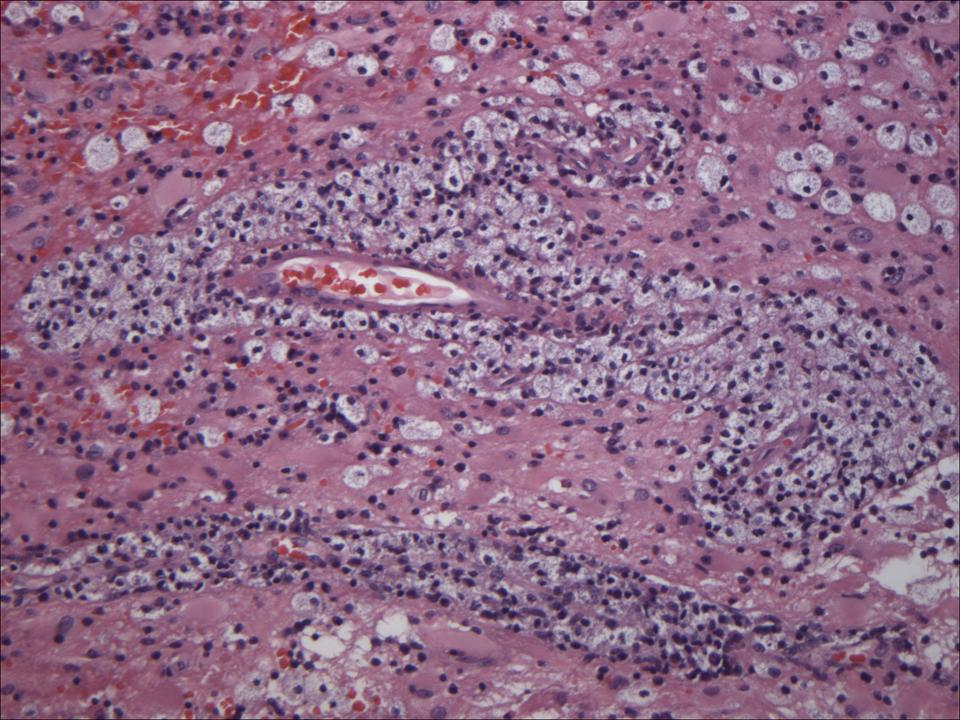
Macrophages were also present:

The following stains for organisms were all NEGATIVE: AFB, GMS, HSV1, HSV2, CMV, HHV8, and toxoplasma. An H&E/LFB stain demonstrated that this was a leukoencephalopathic process:


Immunohistochemistry of one of the lymphoid follicles indicated that the lymphoid infiltrate was a reactive, rather a neoplastic process:

Polyoma virus immunohistochemistry for the SV40 (a surrogate marker for JC virus due to cross-reactivity) was found to be positive:
So, the final diagnosis rendered was Progressive Multifocal Leukoencephalopathy (PML) with concomitant Immune Reconstitution Inflammatory Syndrome (IRIS). IRIS is an inflammatory response in HIV-infected individuals upon initiation of HAART therapy. The immune response can be so robust as to cause morbidity, particularly with the brain is involved. Thanks to Dr. Camelo-Piragua for providing the images associated with this interesting case, and I wish her the best of luck in her upcoming move to Ann Arbor where she will take a position on the faculty at the University of Michigan!

Monday, June 21, 2010

Sleepless

Neuropathologist Henry Brown, MD, PhD (pictured) recommends the novel Sleepless by Charlie Huston to those in the neuropathology community with an interest in the fatal insomnias. A review on Amazon.com describes the book as a "thriller set in a postapocalyptic Los Angeles, [where] a devastating illness renders the afflicted unable to sleep. In about a year, those with SLP (as the sleepless illness is known) deteriorate and die." Dr. Brown says that the novel may be "a little out there for some of our neuropathologists, perhaps", but a good read nonetheless.

Saturday, June 12, 2010

2010 AANP Diagnostic Slide Session diagnoses revealed

For those of you who missed this evening's diagnostic slide session, here are the diagnoses that were ultimately revealed:

1. Phosphaturic mesenchymal tumor, mixed connective tissue variant
2. Primary Solitary Amyloidoma
3. CNS parenchymal involvement by Kikuchi-Fujimoto disease
4. Teratoma with malignant transformation
5. Progressive Multifocal Leukoencephalopathy with Immune Reconstitution Inflammatory Syndrome
6. Varicella Zoster Virus meningitis with intraparenchyal hemorrhage
7. Aneurysmal hemorrhage due to isolated intracranial giant cell arteritis
8. Canine distemper viral encephalitis in a Bengal tiger
9. Feline spinal cord leukomyelopathy secondary to consumption of irradiated dry food diet
10. Acute Hemorrhagic Leukoencephalitis (Weston Hurst disease)
11. Frontotemporal lobar degeneration with ubiquitin proteasome system inclusions (FTLD-UPS) with cerebellar involvement
12. Neimann Pick type C1 disease (compound heterozygote)

As you can see, it was the usual array of simple diagnoses!!!

Friday, June 11, 2010

Two more neuropathology job opportunities listed on announcement board at annual AANP meeting

Dr. Harry Vinters (pictured), in a conversation I just had with him in the refreshment area at the annual AANP meeting, told me that when a trainee complains about the paucity of jobs in neuropathology, he simply refers them to Neuropathology Blog! As you can see in the job listings section of this blog, opportunities for clinical neuropathologists are abundant -- as long as you are willing to relocate. I just checked the announcements bulletin board at the meeting, and discovered two new jobs that I am only now adding to the blog job posting list. Dr. Adekunle Adesina at Texas Children's Hospital/Baylor College of Medicine is looking for a neuropathology faculty member. He can be reached at amadesin@texaschildrens.org. Also, Dr. Steven Chin of the University of Utah in Salt Lake City is seeking a neuropathologist at the assistant or associate level. Dr. Chin can be reached at steven.chin@path.utah.edu. Happy hunting!

Thursday, June 10, 2010

86th Annual AANP Meeting: Rapamycin as a possible treatment for tuberous sclerosis

Drs. David Louis (AANP president) and Anat Stemmer-Rachamimov put together a nice day-long educational session today to kick off the American Association of Neuropathologists annual meeting here in Philadelphia. In addition to our own kind, non-neuropathologists were brought in to give their persepctives on these syndromes. For instance, Dr. Elizabeth Henske (pictured), an oncologist, talked about the spectrum of clinical manifestations seen in tuberous sclerosis complex (TSC) and experiemental therapeutics based on understanding the molecular underpinnings of the syndrome. Given that the genes mutated in tuberous sclerosis (TSC1 and TSC2) inhibit mTOR, Henske said that researchers are looking into the use of rapamycin, an inhibitor of mTOR, as a treatment for not only the more obvious manifestations of TSC, such as subependymal giant cell astrocytoma, but even for reversing learning deficits in children with TSC. In a mouse model of TSC in which there is no pathological evidence of brain lesions, it was discovered that these mice have cognitive defects as evidenced by water-maze testing. "And the thing that just gives me shivers to think about," says Henske, "is that these cognitive deficits are correctable with rapamycin. Five days of rapamycin! So that has caused a big shift in the thinking about children with tuberous sclerosis who have cognitive defects and many parents are actually putting their children on rapamycin off-trial, but we would really like to do a cognitive trial and figure out whether there is benefit in children with tuberous sclerosis who are taking rapamycin. The parents, many of them, have very compelling anecdotal studies of improvement in their childrens' learning or behavior." Therefore, Dr. Henske will be working on an efficacy and safety trial, with funding from the Tuberous Sclerosis Alliance, to see if rapamycin can improve cognitive function in these children. "If there is benefit with rapamycin neurocognitively, it would just be wonderful."

Thursday, June 3, 2010

American Association of Neuropathologists happens next week

The American Association of Neuropathologists' annual meeting will be held in Philadelphia next week -- from June 10 to June 13. I'll be there -- blogging live -- with comments from participants, summaries of cutting-edge presentations, and news from the world of neuropathology.  Among the offerings will be a lecture on Autoimmune Synaptic Encephalitis by Dr. Josep Dalmau (pictured) of the University of Pennsylvania. Numerous other presentations are planned, including the Presidential Symposium, entitled: "Big Science" and the Transition to Personalized Medicine: How Can Neuropathologists Play a Role in Large-Scale Clinical, Translational and Basic Research?  I myself will appear at a panel on Friday the 11th at the trainee luncheon, where I'll be talking about landing your first job. I'll be joined on the panel by Dr. Suzanne Z. Powell who will discuss neuropathology training and Dr. Tony Yachnis who will talk about mentorship and sustainability. I look forward to the event and to meeting a few Neuropathology Blog readers along the way!

Neuropathology Blog is Signing Off

Neuropathology Blog has run its course. It's been a fantastic experience authoring this blog over many years. The blog has been a source...