 |
| Dr. Edward B. Lee |
Tuesday, July 19, 2011
Formal Guidelines for Alzheimer's Genetic Testing Issued


Monday, July 18, 2011
Time Magazine On-Line Article: NFL Players May Be More Vulnerable to Alzheimer's Disease

Thursday, July 14, 2011
According to the Greeks, the term "camptocormia" is being misused!
 |
| Arkady Melikyan, MD |
Thursday, July 7, 2011
Dr. Jean-Paul Vonsattel is on YouTube
 |
| Jean-Paul Vonsattell, MD |
Friday, July 1, 2011
Dr. Mike Lawlor provides jobs update from last week's AANP annual meeting
Today I feature a guest post from the esteemed Dr. Mike Lawlor regarding the job fair held at last week's annual meeting of the American Association of Neuropathologists (AANP):
 |
| Michael W. Lawlor, MD, PhD |
As many of you know, this year’s AANP meeting in Seattle included a job fair, and I’d like to extend my gratitude once again to Arie Perry, Steve Moore, and Brian Moore for their efforts in organizing the event. As an attendee of this job fair, I’ve compiled some very brief descriptions of the jobs that were described there, which are shown below. In addition, several institutions that could not attend sent me brief summaries of their positions, which I have also synopsized below. Overall, it seemed like the job fair went very well, and I’d like to thank the representatives of these hiring institutions for their involvement in the event. Good luck to the applicants and potential employers alike.
The following institutions (in alphabetical order) either presented or sent emails about the job fair and described the following positions and areas of interest. Even if your area of interest differs from that described, I’d encourage you to contact these institutions, since many of them expressed a willingness to be flexible on a number of things.
Case Western: Their job search is still open, and they are interested in a research-oriented neuropathologist. The amount of clinical work can be very flexible, and a person could be 100% research if they wanted. They are very well set up for a person interested in tumors, but would be flexible in terms of research interest.
Johns Hopkins: Their job search is still open, and they are interested in a research-oriented neuropathologist (~75%) who is interested in neurodegeneration. The point was also made that you must also be a nice person, so keep that in mind…
Ohio State: Their job search is still open, and they are interested in a research-oriented neuropathologist (~75%), with no specific field of interest specified. It sounded as if they might be flexible on a number of issues.
Texas Children’s Hospital: Their job search is still open, and they are interested in a research-oriented neuropathologist with an interest in pediatric disease. Specifically, an interest in development would be ideal.
UC Davis: Their job search is still open, and the primary round of applications was reviewed on June 30th.
UCSF: Their job search is still open, and they are interested in a research-oriented neuropathologist (~75% research) who is interested in neurodegeneration.
UW Madison: Announced an opening for a research oriented neuropathologist with an interest in neurodegeneration. They will formally announce the position and details soon.
Virginia Mason Medical Center: Their job search is still open, and they are looking for a clinically oriented neuropathologist who would like to sign out neuropath and surgical path. It sounds as if the majority of their volume is general surgical path, but that they would really like to get a neuropathologist for the neuro cases that come through the service.
Thank you, Mike, for your hard work on organizing this jobs fair. By the way, Dr. Lawlor himself has been successful in his recent job search, landing a staff position at Children's Hospital of Wisconsin starting in September. He is currently finishing up a research fellowship at Children's Hospital Boston.
Wednesday, June 29, 2011
Looking for pictures? PathologyPics.com has plenty
Dr. Roger E. McLendon called my attention to PathologyPics.com a very good, pictorially-oriented general pathology website which includes many examples of both classic and rare brain tumors. Here, for example, is an example from the site of a chordoid glioma of the third ventricle:


Thanks, Dr. McLendon, for pointing out this helpful website.
Thursday, June 23, 2011
I have discovered my ApoE status
I just got my ApoE results back from 23andMe.com. When I ordered the test, the first question I posed to readers was whether it was wise to even find out whether or not I have the epsilon 4 allele. One commentator, "Agent 86", quoted the ancient Greek philosopher Epictetus for guidance on this issue. In 135 AD, Epictetus argued that one should emotionally separate oneself from those things which are not one's own -- i.e., those things over which one has no control. Therefore, had he known what a gene was at the time, Epictetus would have counted one's genome as among those things that is not one's own. As such, knowing his ApoE status would have been of no consequence either way to Epictetus. I do find it rather easy to take this Epictetusian attitude toward my ApoE status. But because I find it exceedingly difficult to adopt this attitude of separateness toward many other things in my life over which I have no control, I can certainly understand how others could feel emotionally affected by knowledge of their own ApoE status.
I then had a second question: Should I make my ApoE results public? I was surprised by the number of people who recommended against doing so. The main objection seemed to be the potential that an insurance company might refuse to cover me if it were known that I was at increased risk for the development of Alzheimer's disease. I agree with one commentator who stated that this is a "worst-case scenario" and continually worrying about worst-case scenarios is not a wise way to live one's life. I might also add that it might be in an insurance company's best interest for me to get Alzheimer's disease at a relatively earlier age (in my 60's rather than in my 80's) as I would likely die at a younger age and thereby cost the company less money over the long run. That being said, in deference to all those who weighed in on this matter, I have elected not to publicly share my ApoE status. I appreciate all those who engaged in this discussion; and I suspect that this kind of discussion will be ongoing in many circles in the decades to come as personalized medicine, based on genomic profiling, emerges in the new age of theragnostics.
I then had a second question: Should I make my ApoE results public? I was surprised by the number of people who recommended against doing so. The main objection seemed to be the potential that an insurance company might refuse to cover me if it were known that I was at increased risk for the development of Alzheimer's disease. I agree with one commentator who stated that this is a "worst-case scenario" and continually worrying about worst-case scenarios is not a wise way to live one's life. I might also add that it might be in an insurance company's best interest for me to get Alzheimer's disease at a relatively earlier age (in my 60's rather than in my 80's) as I would likely die at a younger age and thereby cost the company less money over the long run. That being said, in deference to all those who weighed in on this matter, I have elected not to publicly share my ApoE status. I appreciate all those who engaged in this discussion; and I suspect that this kind of discussion will be ongoing in many circles in the decades to come as personalized medicine, based on genomic profiling, emerges in the new age of theragnostics.
Tuesday, June 21, 2011
What's wrong with finding out and releasing my ApoE status?
In a recent blog post, I stated that I intended to publish my ApoE status on the blog when I get the results back from 23andMe.com. I was surprised to find that some people objected to this. One associate said that by publishing information about my genetic status, I would be "normalizing" the dissemination of information that should be confidential. That sets a bad precedent for the use of personal genomic data. Another individual emailed me the following suggestion: "Instead of posting your results, maybe you would consider instead the value of not doing so at the request of an 'anonymous' reader and keeping the information private in order to stimulate debate about finding out about a disease process for which there is no cure." Finally, "jd" commented in the original post about the wisdom of getting the test done at all: "Why would you do that? If you come back 4/4 or 3/4, that'll be hanging over you the rest of your life. If there were a cure for Alzheimer's, that'd be different."
Tuesday, June 14, 2011
A 58-year-old woman presenting with headache and unsteadiness of gait
Here's a recent case of mine involving a lesion in the third ventricle of a 58-year-old woman who presented with headache and unsteadiness of gait. First, the imaging:
The neuroradiologist thought perhaps the lesion was a craniopharyngioma. But, the neurosurgeon was surprised that the lesion seemed to "pop out". Here's the specimen I received:
I smeared some of the viscous fluid from the cut surface onto a glass slide, cover-slipped it, and viewed it under polarized light:


Those cholesterol crystals certainly seem to suggest the possibility of craniopharyngioma. But, craniopharyngiomas do not have a smooth outer surface and do not just "pop out" into the neurosurgeon's hand. Here was my first glimpse of the histology the next day:
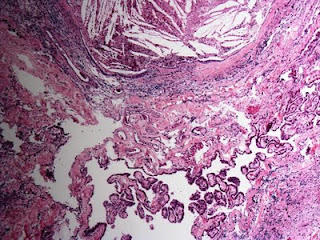
 Cholesterol clefts and giant cells. Note in the upper picture that this xanthogranulomatous reaction appears to be continuous with the choroid plexus. Could this be a xanthogranuloma of the choroid plexus? I considered that, until I looked elsewhere on the slide and saw this:


This is the ciliated epithelium characteristic of a colloid cyst of the third ventricle, a tumor that can indeed "pop out" into the neurosurgeon's hand. Gross inspection did not reveal a cyst per se because the exuberant xanthogranulomatous reaction obliterated it. Cases like this have been described in the literature. For example, Dr. David Louis and colleagues wrote in a 1994 article entitled Third ventricle xanthogranulomas clinically and radiologically mimicking colloid cysts: Report of two cases (Journal of Neurosurgery. 81(4):605-9, 1994 Oct.) that "histopathologic examination revealed xanthogranulomas of the choroid plexus with only microscopic foci of colloid cyst-like structures." I would argue quite the opposite: that the xanthogranuloma derived from the colloid cyst and extended into the choroid plexus. Indeed, Dr. Peter Burger and colleagues write in the fourth edition of Surgical Pathology of the Nervous System and Its Coverings that "a xanthogranulomatous reaction occasionally supervenes in colloid cysts, largely replacing the epithelium in some cases."
Cool case.
 | |
| Axial CT |
 |
| Sagittal T1 MRI |
 |
| Axial T2 MRI |
 |
| Coronal Gradient Echo |
 |
| Outer Surface |
 |
| Cut Surface |


Those cholesterol crystals certainly seem to suggest the possibility of craniopharyngioma. But, craniopharyngiomas do not have a smooth outer surface and do not just "pop out" into the neurosurgeon's hand. Here was my first glimpse of the histology the next day:


This is the ciliated epithelium characteristic of a colloid cyst of the third ventricle, a tumor that can indeed "pop out" into the neurosurgeon's hand. Gross inspection did not reveal a cyst per se because the exuberant xanthogranulomatous reaction obliterated it. Cases like this have been described in the literature. For example, Dr. David Louis and colleagues wrote in a 1994 article entitled Third ventricle xanthogranulomas clinically and radiologically mimicking colloid cysts: Report of two cases (Journal of Neurosurgery. 81(4):605-9, 1994 Oct.) that "histopathologic examination revealed xanthogranulomas of the choroid plexus with only microscopic foci of colloid cyst-like structures." I would argue quite the opposite: that the xanthogranuloma derived from the colloid cyst and extended into the choroid plexus. Indeed, Dr. Peter Burger and colleagues write in the fourth edition of Surgical Pathology of the Nervous System and Its Coverings that "a xanthogranulomatous reaction occasionally supervenes in colloid cysts, largely replacing the epithelium in some cases."
Cool case.
Tuesday, June 7, 2011
The Link Between ApoE4 and Chronic Traumatic Encephalopathy appears to be weakening
 |
| Dr. Robert Cantu |
(Reference: Katsnelson A, Gene tests for brain injury still far from the football field. Nature Medicine. June 2011. 17:6, p. 638)
Monday, June 6, 2011
American Brain Banking Network renamed the International Brain Banking Network, with new website
 |
| Piotr B. Kozlowski, MD, PhD |
From Dr. Piotr B. Kozlowski, Touro College of Osteopathic Medicine, New York City:
"The website of the brain banking network formerly known as the American Brain Banking Network (ABBN), is now renamed as the International Brain Banking Network and its website can be found at http://www.intbbn.org/
"Please have a look at this website, still in a nascent state, and if the information regarding your brain/tissue bank needs to be updated, please let me know."
Subscribe to:
Posts (Atom)
-
 Shannon Curran, MS with her dissection Shannon Curran, a graduate student in the Modern Human Anatomy Program at the University of Co...
-
 According to a recent Associated Press report , singer Michael Jackson's brain was removed from his skull and is being held for further ...