 A new book covering peripheral nerve diseases (part of the International Society of Neuropathology series) is about to be released . The book editors are Jean-Michel
Vallet and Joachim Weiss and includes chapters from a range of other
international experts who have produced a clinically orientated guide to
the pathology of peripheral nerve disorders. The book includes the latest
molecular and pathological findings to provide the most up-to-date
understanding of the pathogenesis of these disorders.
A new book covering peripheral nerve diseases (part of the International Society of Neuropathology series) is about to be released . The book editors are Jean-Michel
Vallet and Joachim Weiss and includes chapters from a range of other
international experts who have produced a clinically orientated guide to
the pathology of peripheral nerve disorders. The book includes the latest
molecular and pathological findings to provide the most up-to-date
understanding of the pathogenesis of these disorders.
Friday, September 26, 2014
New ISN book – Peripheral Nerve Disorders – coming soon
A new book covering peripheral nerve diseases (part of the International Society of Neuropathology series) is about to be released . The book editors are Jean-Michel
Vallet and Joachim Weiss and includes chapters from a range of other
international experts who have produced a clinically orientated guide to
the pathology of peripheral nerve disorders. The book includes the latest
molecular and pathological findings to provide the most up-to-date
understanding of the pathogenesis of these disorders.


Wednesday, September 24, 2014
Best Post of July 2014: 3D print of white matter "captures a sense of delicate complexity that evokes a sense of wonder about the brain"
The next in our "Best of the Month" series is from July 2, 2014:
Creating an accurate 3D model of the brain's white matter for Philadelphia's Franklin Institute was a project no 3D printing company would tackle -- until 3D Systems (Rock Hill, SC) agreed to take it on. Here is an image of the finished project, which took about 210 hours to print out:
 Interviewed for the tech website CNET, Franklin Institute chief bioscientist and lead exhibit
developer Dr Jayatri Das said that the model "has really become one of the iconic pieces of the exhibit. Its sheer
aesthetic beauty takes your breath away and transforms the exhibit
space," said . "The fact that it comes from real data adds a
level of authenticity to the science that we are presenting. But even if
you don't quite understand what it shows, it captures a sense of
delicate complexity that evokes a sense of wonder about the brain."
Interviewed for the tech website CNET, Franklin Institute chief bioscientist and lead exhibit
developer Dr Jayatri Das said that the model "has really become one of the iconic pieces of the exhibit. Its sheer
aesthetic beauty takes your breath away and transforms the exhibit
space," said . "The fact that it comes from real data adds a
level of authenticity to the science that we are presenting. But even if
you don't quite understand what it shows, it captures a sense of
delicate complexity that evokes a sense of wonder about the brain."
Thanks to the illustrious Dr. Doug Shevlin for informing me of this remarkable feat of engineering which, in his words, sits at "the intersection of neuroscience, computers and 3D printing".
Thanks to the illustrious Dr. Doug Shevlin for informing me of this remarkable feat of engineering which, in his words, sits at "the intersection of neuroscience, computers and 3D printing".
Friday, September 12, 2014
PBS's Frontline Spotlights Neuropathology in Documentary Film
In the film, which airs Tuesday, Oct. 8 beginning at 9 pm EST,
FRONTLINE investigates the hidden story of the NFL’s response to head
injuries. Through interviews with former players, scientists and neuropatholgists, it examines what the NFL knew about the
risks of chronic traumatic encephalopathy (CTE), and when it knew it. Dr. Bennet Omalu, the first neuropathologist to draw a connections between playing football and the development of CTE, is featured in this remarkable documentary.
See a six-minute preview of the film here.
Thanks to Dr. Doug Shevlin sending me this link.
See a six-minute preview of the film here.
 |
| Dr. Bennet Omalu, the first pathologist to posit the connection between CTE and playing football |
Thanks to Dr. Doug Shevlin sending me this link.
Tuesday, September 9, 2014
Amyloid-beta and neurofilament in 3D
From:Kunie A, et al. Inside Alzheimer brain with CLARITY: senile plaques, neurofibrillary tangles and axons in 3D. Acta Neuropathologica. September 2014, Volume 128, Issue 3, pp 457-459.
Thanks to Dr. Mark Cohen of Case Western for sending me the link.
Monday, September 8, 2014
Best Post of June 2014: Higgins Leads Athena's Quest for More Specific Epilepsy Diagnoses
The next in our "Best of the Month" series is from Thursday, June 5, 2014:
 |
| Joseph J. Higgins, MD |
Among the topics we discussed is Athena's new advances in helping clinicians diagnose autoimmune epilepsy disorders. A growing body of evidence points to an autoimmune etiology for a proportion of drug-resistant epilepsy cases. Dr. Higgins, with the horsepower of Athena's parent company Quest Diagnostics behind him, is leading the way in making auto-antibody testing available to patients with intractable epilepsy. While patients with pathogenic auto-antibodies often experience heightened adverse effects and typically respond poorly to conventional treatment, they can respond very well to immunomodulatory therapy. Autoantibodies to surface proteins that influence neuronal excitability have been found in the serum and cerebral spinal fluid of well over 10% of patients with epilepsy—whether the epilepsy was newly-diagnosed or established. In many cases, once identified, autoimmune epilepsy can be slowed, halted, or even reversed with adjunctive immunotherapy. Testing to establish an accurate diagnosis is an important part of selecting an optimal treatment plan. In a recent study (see reference below), 81% of adult patients diagnosed with autoimmune epilepsy experienced significant improvement in seizure status when immunotherapy was used in combination with anti-epileptic medications; 67% achieved complete seizure freedom.
Among the clinical syndromes that can be investigated using CSF auto-antibody assays are Morvan's Syndrome (by testing for VGKC complex, predominantly CASPR2) and NMDA Receptor Antibody Encephalitis (by testing for NMDA receptor, NR1 subunit). Dr. Higgins is at the forefront of personalized epilepsy treatment. Athena's advances in this field will ultimately improve patient outcomes while reducing medical costs.
Reference: Quek AM, Britton JW, McKeon A, et al. Autoimmune epilepsy: clinical characteristics and response to immunotherapy. Arch Neurol 2012;69:582-93.
Monday, August 25, 2014
Best Post of May 2014: Primary Progressive Aphasia (non-fluent/agrammatic variant) in a patient with Pick disease
The next in our "Best of the Month" series is from May 14, 2014:
I recently performed an autopsy on a 67-year-old man had a seven-year history of progressive difficulty with halting speech. His wife described him as seeming to be “groping for words”. Three years after initial presentation, he demonstrated profound difficulty both initiating and finishing sentences. His verbal communication was marked by jumbled grammatical errors in which he put words in the wrong order and tense. For example, when asked by his neurologist to recount his activities over the day, he responded: “Go I… the grocery store… to.” He had no difficulty with naming objects or understanding their use. He had only mild amnestic deficits and no visuospatial difficulties. During the last months of his life, he began to become more rigid in his personality and more socially withdrawn.The clinical diagnosis in this patient is primary progressive aphasia, non-fluent/agrammatic variant. The pathologic diagnosis is frontotemporal lobar degeneration with 3R tau inclusions (FTLD-tau), commonly known as Pick disease. The clinical presentation of FTLD can be divided into two types: the behavioral variant (bvFTLD) and primary progressive aphasia (PPA). Neurologists subclassify PPA into three subtypes: semantic variant (sv-PPA), non-fluent/agrammatic variant (na-PPA), and logopenic/phonologic variant (lv-PPA). While sv-PPA and na-PPA generally correspond to FTLD pathology, lv-PPA typically corresponds to Alzheimer disease (AD) pathology (and is accordingly referred to as the “language variant” of AD). The syndrome of na-PPA is characterized by predominant language dysfunction in which there is a disordering of words in sentences, an inability to repeat complex words (e.g., saying “castaphory” when asked to repeat back the word “catastrophe”), inability to construct complex sentences, and other deficits in grammar and phonology. In contrast, a diagnosis of sv-PPA is given to patients who exhibit a general deficit in their ability to understand word and object meaning. Patients with sv-PPA also show difficulty in naming objects and understanding what they are used for. A diagnosis of bvFTLD is ruled out as this patient only showed behavioral changes only late in the disease course
Pick disease was demonstrated pathologically by the presence of 3R tau positive Pick bodies (see photomicrograph) in the frontal and temporal lobes as well as the dentate fascia of the hippocampus, cornu Ammonis of the hippocampus, presubiculum, cingulate gyrus, insula, and inferior parietal lobe.
 |
| 3R tau positive Pick body in the inferior temporal gyrus |
For the practicing neuropathologist, FTLD’s
are not yet classified on a molecular basis (although some day they surely will be), but rather according to the particular
protein aggregation which is detected using immunohistochemistry. The five possible
FTLD subtypes, based on specific associated protein aggregations, are
represented in the following table:
FTLD
type
|
Associated
Protein Aggregation
|
FTLD-tau
|
Tau (can be further
subclassified into 3-repeat [3R], 4-repeat [4R], or 3R+4R tau)
|
FTLD-TDP
|
Transactive response DNA-binding protein of 43 kDa (TDP-43)
|
FTLD-FUS
|
Fused in sarcoma (FUS)
|
FTLD-UPS
|
Ubiquitin (with UPS standing
for ubiquitin-proteasome system)
|
FTLD-ni
|
No immunoreactivity
|
In 80% of cases of sv-PPA, the underlying histopathology is that of FTLD-TDP; while in the majority of na-PPA cases, the pathologic substrate is FTLD-tau. Although not denoting a specific clinical syndrome, the term “Pick disease” has come to denote FTLD-tau, particularly referring to aggregation of the tau isoform in which there are three repeats (3R) of the phosphate-binding domain.
References:
Sieben A, Van Langenhove T, Engelborghs S, et al. The genetics and neuropathology of frontotemporal lobar degeneration. Acta Neuropathol. 2012;124(3):353-372.
Thursday, August 21, 2014
35-year-old woman who died after a presumed seizure episode
A 35-year-old woman died after a witness saw her "foaming at the mouth". A seizure was presumed to have occurred by emergency personnel. At autopsy, there was mild dilatation of the lateral and third ventricles:

This translucent mass was identified in the third ventricle:

Histological examination of the cyst contents revealed:

Although no ciliated epithelium was identified within the specimen, there were columnar cells with a pseudostratified configuration:
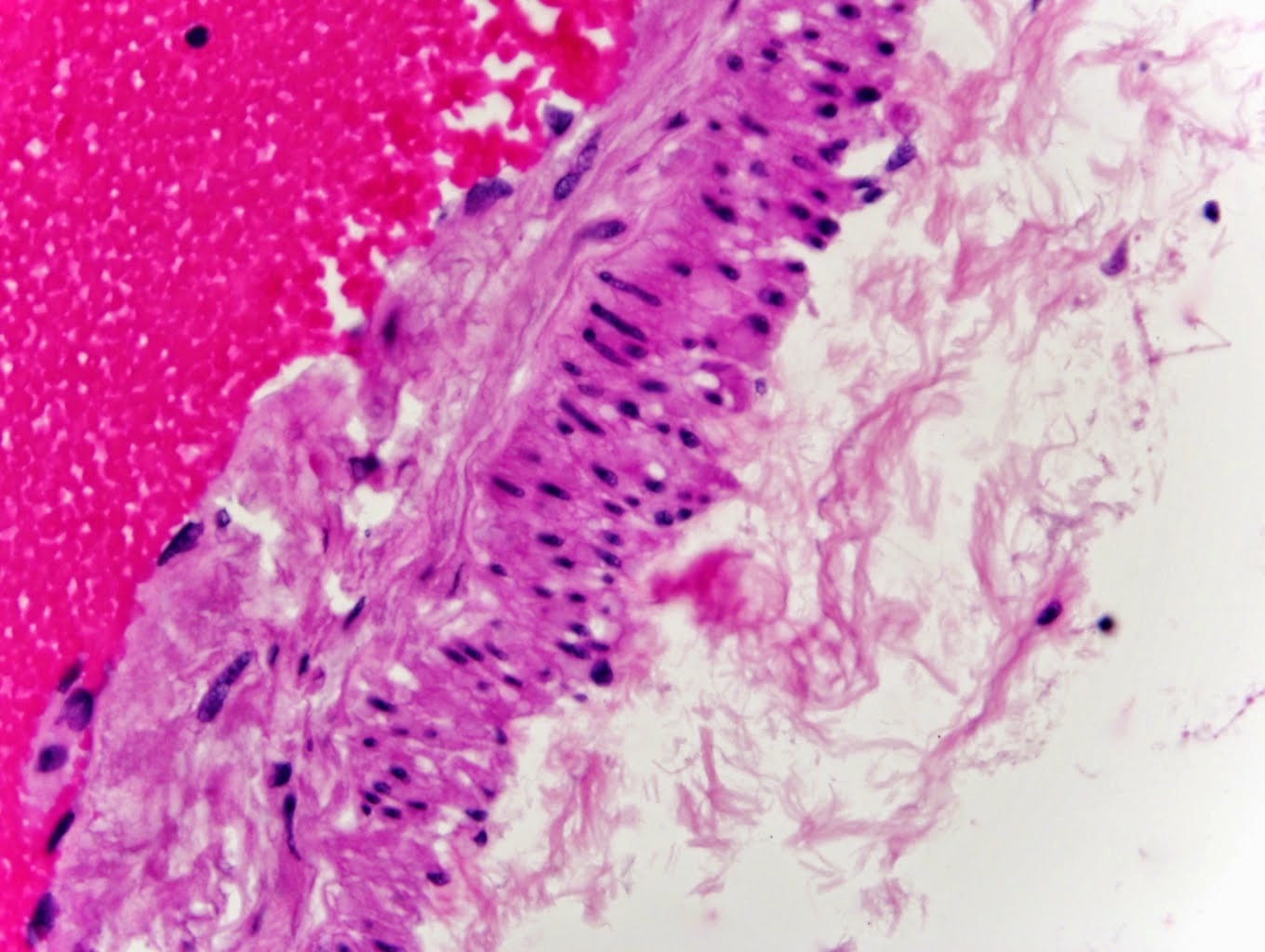
However, the majority of the cyst lining was flattened, simple epithelium:

Diagnosis? (Please post to comments)
This translucent mass was identified in the third ventricle:
Histological examination of the cyst contents revealed:
Although no ciliated epithelium was identified within the specimen, there were columnar cells with a pseudostratified configuration:
However, the majority of the cyst lining was flattened, simple epithelium:
Diagnosis? (Please post to comments)
Tuesday, August 19, 2014
Dr. Peter Cummings Challenges Neuropathologists to Ice Bucket Challenge
 |
| Peter Cummings, MD |
Monday, August 18, 2014
Best Post of April 2014: Nobel Laureate Prusiner Tells His Story

Just published by Yale University Press: Stanley Prusiner's new book, Madness and Memory: The Discovery of Prions - A New Biological Principle of Disease, is now available for purchase. Although I am not personally a big fan of Dr. Oliver Sacks's work, his blurb on Prusiner's book is worth reading: “Stanley Prusiner is a brilliant scientist whose boldness and tenacity enabled him, against all odds and despite near-universal skepticism, to discover and prove the importance of a new class of disease-producing agents—prions—a discovery as fundamental as that of bacteria and viruses. Prions, by subverting the brain’s own proteins, may play a crucial role in Alzheimer’s, Parkinson’s, and other neurodegenerative diseases—and perhaps afford a clue to their prevention. Madness and Memory is the story of one of the most important discoveries in recent medical history, and it is also a vivid and compelling portrait of a life in science." Special thanks to Dr. Mark Cohen for alerting me to the publication of this new account of a seminal discovery in biological science.
 | |
| The bookish Dr. Mark Cohen |
Monday, August 11, 2014
Best of March 2014: Vulnerability of Glioblastoma Cells to Catastrophic Vacuolization and Death Induced by a Small Molecule
 The next in our "Best of the Month" series is from March 21, 2014:
Researchers at the Karolinska Institute in Sweden have introduced what could possibly be a revolution in glioblasoma treatment. In a recent article in Cell, researchers found that molecules known as vacquinols "reliably and selectively compromised" neoplastic cell viability. Vacquinols stimulate cell death by membrane ruffling, vacuolization, and -- ultimately -- cytoplasmic membrane rupture. Although in vivo testing has been restricted to mice thus far, this paper may prove to be the beginning of a new avenue of research into the selective killing of glioblastoma cells in patients.
Monday, August 4, 2014
Best Post of February 2014: Seizing Control of Brain Seizures
The next in our Best of the Month series comes from February 27, 2014:
How can trauma lead to chronic seizures? Berkeley researcher Daniela Kaufer found that only when albumin in the blood breaches the blood-brain barrier does the likelihood of post-traumatic epilepsy go up. Accelerated signaling between neurons results from this exposure, leaduing to seizures. “We were surprised, even a little disappointed, that it was such a common component of the blood – nothing exotic at all – that led to epilepsy,” recalls Kaufer, associate professor of integrative biology. She and colleagues went on to
show that albumin interacts with a ubiquitous cell protein TGF-Beta receptor
to cause the damage. In the healthy brain, TGF-Beta signaling affects
activity of astrocytes, which normally limit
neuron-to-neuron firing signals across the synapse. But when albumin
stimulates TGF-Beta receptors, astrocytes lose some of their control.
Neuron signaling then spike dangerously, and promote the development of
epileptic seizures. As luck would have it, statin drugs block
TGF-Beta signaling. Kaufer
is now carrying out research to confirm that blocking abnormal TGF-Beta
activity can prevent epilepsy from a range of insults. “Right now, if
someone comes to the emergency room with traumatic brain
injury, they have a 10 to 50 percent chance of developing epilepsy. But
you don’t know which ones, nor do you have a way of preventing it. And
epilepsy from brain injuries is the type most unresponsive to drugs."
says Kaufer. “I’m very hopeful and that our research can spare these
patients the added trauma of epilepsy.”
(Thanks to Dr. Doug "Scout" Shevlin for alerting me to this potentially groundbreaking research.)
How can trauma lead to chronic seizures? Berkeley researcher Daniela Kaufer found that only when albumin in the blood breaches the blood-brain barrier does the likelihood of post-traumatic epilepsy go up. Accelerated signaling between neurons results from this exposure, leaduing to seizures. “We were surprised, even a little disappointed, that it was such a common component of the blood – nothing exotic at all – that led to epilepsy,” recalls Kaufer, associate professor of integrative biology. She and colleagues went on to
 |
| Daniela Kaufer in the lab |
(Thanks to Dr. Doug "Scout" Shevlin for alerting me to this potentially groundbreaking research.)
Subscribe to:
Posts (Atom)
-
 Shannon Curran, MS with her dissection Shannon Curran, a graduate student in the Modern Human Anatomy Program at the University of Co...
 -
 Dr. PJ Cimino , whom we profiled when he was a fellow back in November of 2013, is a now faculty member at the University of Washington. I ...