Wednesday, October 16, 2019

Best Post of June 2019: American Association of Neuropathologists annual meeting gets underway

The next in our "Best of the Month" series is from Wednesday, June 5, 2019:

I arrived in Atlanta this afternoon in anticipation of tomorrow's kick-off of the American Association of Neuropathologists annual meeting. I've already run into a number of neuropathologists from around the country, including: Howard Chang, William Taylor, Eddie Lee, Beatriz Lopes, Roberta Seidman, Doug Miller, Mary Fowkes, Clare Bryce, Ray Sobel, Tessa Hedley-White, and Leroy Sharer. Looking forward to a great meeting!


I caught up with the inimitable Dr. Leroy Sharer (right) while checking in for the meeting

Wednesday, October 9, 2019

Guest Post from Dr. Eddie Lee: "AANP Scholars" Program Initiated

This just in from the inimitable Dr. Eddie Lee of the University of Pennsylvania:

Edward Lee, MD, PhD

“There is a recognized national need for more research-oriented neurodegenerative disease neuropathologists. Towards that end, the American Association of Neuropathologists was awarded a grant from the NIA/NIH that will provide funds for 20 “AANP Scholars” to attend a trainee career development workshop (co-directed by Drs. Eddie Lee and Julia Kofler).  The workshop will be held once a year for three consecutive years in association with the annual AANP meeting.  This is a great opportunity for any trainee interested in neurodegenerative disease neuropathology.  The grant will support AANP Scholars by providing funds for travel, hotel, and registration to the annual AANP meeting.  Applications are due November 1st.  Women, underrepresented minorities and persons with disability are particularly encouraged to apply.” Here's the link to apply.

Monday, October 7, 2019

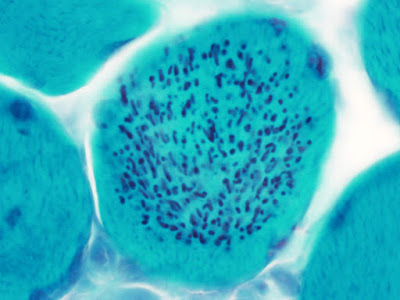
Cytoplasmic bodies in a muscle biopsy

The inimitable Dr. Christian Davidson, formerly of Robert Wood Johnson Medical School at Rutgers and now at the University of Utah, sent in pictures of cytoplasmic bodies in a muscle biopsy from a patient with severe myositis. Thank you, Dr. Davidson!

Trichrome

Electron Microscopy

Tuesday, September 24, 2019

A new neuroscience educational channel debuts on YouTube

Phedias Diamandis
Dr. Phedias Diamandis of the University of Toronto shared with me a new YouTube channel -- called NeuroscIQ --  which he and his colleagues have developed. This neuroscience educational initiative, according to Dr. Diamandis, is designed "to discuss relevant everyday neuroscience theory and pathways for early trainees". Right now, there is some neuropathology on the channel, but there's more to come. This channel adds to the excellent neuroscience and neuropathology content that is now on YouTube. We are approaching a day when live lectures to our residents and medical students will become an anachronism. Why not let trainees watch these excellent online presentations before meeting, and then spend your time together interactively discussing the material presented on YouTube? Thank you, Dr, Diamandis!


Thursday, September 19, 2019

Edward Stopa, long-time neuropathologist at Brown University, passes away

Edward Stopa, MD, 65, after a brief and courageous battle with pancreatic cancer. He touched many lives and served as mentor to many in neuropathology, including me. Since 1993, Ed was the director of neuropathology at Brown and led the division until his retirement earlier this year. I was a neuropathology fellow under his directorship from 2004-06 and fondly remember his sense of humor, curiosity, and joie de vivre.

Ed made many strides in the understanding of Alzheimer disease through close collaborations with basic and clinical neuroscientists. He contributed extensively to our knowledge of the hypothalamic mechanisms that are responsible for human reproduction and circadian rhythm.

We will miss you, Ed.

Thursday, August 29, 2019

Inova Neuropathology and Neuroradiology Course Takes Place January 13-17, 2020

Hsiang-Chih (Sean) Lu, MD, PhD
Dr. Hsiang-Chih (Sean) Lu, MD, PhD, neuropathology fellow at Washington University in St. Louis, writes the following:

"There is an annual neuroradiology and neuropathology review course held by Inova. It has a fantastic line-up of speakers but unfortunately it’s not very well known in the pathology field. I thought it may be a good idea to mentioned this on your blog so more people (particularly trainees) know about this course."

A valuable course indeed! Thanks for the reminder, Dr. Lu.


Wednesday, August 28, 2019

Dr. Craig Horbinski to deliver webinar entitled "Understanding Molecular Characteristics of Tumors and Implications for Treatment" on September 16


The Society for Neuro-Oncology is initiating a series of webinars as part of it online education effort. To kick off our new webinar series, Dr. Craig Horbinski from Northwestern Medicine/Feinberg School of Medicine will present "Understanding Molecular Characteristics of Tumors and Implications for Treatment" on Monday, September 16, 2019 at 10:00am Central.
Craig Horbinski, MD, PhD

Register for the webinar by clicking here.

Learning objectives
• Explain the importance of advanced molecular testing in the workup of brain tumors • Interpret the results of next-generation sequencing when applied to brain tumors • List the assays, and specific molecular targets, currently recommended for the workup of brain tumors • Discuss the future of methylation profiling on the workup of brain tumors • Allied Health professionals can use the information in educating patients

Target Audience
Allied health professionals, nurses, social workers and therapists in the field of brain tumor research.

Registration
Registration is free but limited to the first 500 participants. All SNO webinars will be recorded. If you are unable to participate live, it will be available to view in SNO’s Online Education Center.


Monday, August 26, 2019

Dr. Fausto Rodriguez lectures on pineal tumors live tomorrow on Pathcast


Tuesday, August 27 - 8 AM EST

Topic: Tumors of the Pineal Region
Presented by Fausto Rodriguez, M.D.,
Associate Professor of Pathology, JHUSOM


This seminar can be accessed live
through the following links at 8 AM on Tuesdsay:


For any questions please contact the creators of PathCast, Dr. Rifat Mannan or Dr. Emelio Mardrigal at pathologycast@gmail.com

To learn more about this and other educational activities from the Department of Pathology visit: http://pathology.jhu.edu/department/training/clinicians.cfm
 

This hour-long PathCast seminar presented by Dr. Fausto Rodriguez will be broadcast live on both Facebook and YouTube.
Live chat will be available for you to discuss the presentation with Dr. Rodriguez during the seminar.


The PathCast will be archived after the live session at:

http://pathology.jhu.edu/department/training/clinicians.cfm


Monday, August 12, 2019

Best Post of April 2019: Progressive Multifocal Leukoencephalopathy in patients without obvious immunosuppression

The next in our "Best of the Month" series comes from Friday, April 12, 2019:

I recently received a case in consultation which turned out to be progressive multifocal leukoencephalopathy (PML). Reading the clinical history, it was not entirely clear what predisposed the patient to PML. It wasn't clear, that is, until my mentor (the illustrious BK DeMasters) referred me to a nine-year-old paper by Sarah Gheuens, Gerald Pierone, Patrick Peeters, and Igor J. Koralnik entitled Progressive Multifocal Leukoencephalopathy in individuals with minimal or occult immunosuppression (J Neurol Neurosurg Psychiatry2010;81:247-254). In this series, hepatic cirrhosis -- which was what my patient had -- was among the more common conditions in PML patients with minimal immunosuppression. Other conditions that can be associated with PML in the minimally immunosuppressed are those with renal failure and idiopathic CD4+ lymphopenia,

The authors discuss the possible mechanisms for the development of PML in patients with hepatic cirrhosis:

"[H]epatic cirrhosis can lead to portal hypertension and hypersplenism, with subsequent leucopenia as white blood cells are sequestrated in the enlarged spleen. Furthermore, cirrhosis also leads to hypogammaglobulinemia... It is well known that cirrhotic patients have a higher risk of developing bacterial infections, and 30–50% of deaths among cirrhotic patients are directly caused by infections. Immune dysfunction in hepatic disease may be caused by altered cytokine production, impaired cellular immune response and vascular disturbances, which lead together to increased susceptibility to infections."

Neuropathology Blog is Signing Off

Neuropathology Blog has run its course. It's been a fantastic experience authoring this blog over many years. The blog has been a source...