Monday, May 30, 2011
Illinois Lawmakers Pass Concussion Bill
I'm glad to see that my state's lawmakers are addressing the issue of sports-related concussions. The policies adopted by the National Football League appear to be trickling down to the high school gridiron. The bill, passed by the Illinois Legislature, now goes to Governor Pat Quinn's desk for his signature.


Wednesday, May 25, 2011
Population prevalence of the ApoE4 gene
Regarding the Alzheimer genotype, I just did a little research regarding the prevalence of the ApoE epsilon 4 allele (the allele that predisposes to Alzheimer disease). Depending on the study you read, about 20% of the population has at least one epsilon 4 allele, while about 2% have two epsilon 4 alleles. As you'd expect, having two is worse than having one in terms of Alzheimer risk. I should add that the epsilon 4 allele also predisposes to a worse outcome in recovery from traumatic brain injury and is also over-represented among those football players who suffer from Chronic Traumatic Encephalopathy.
It's important to note that this data applies only to those of European ancestry. The rates of other ethnic groups are different. I saw one study showing, for example, that the rate of epsilon 4 prevalence is much, much higher among Australian aboriginal populations.  I recently sent in a saliva specimen to 23andMe.com to have their CLIA-approved lab run a genetic profile on me, which will include a report on my ApoE status. The service has dramatically decreased in price in recent years, so I finally broke down made the purchase. I'll report those results when I get them next month. |
Friday, May 20, 2011
The Timeless Dr. Adelman
 |
| Lester S. Adelman, MD |
Pathologists spend their time in the figurative,
and sometimes literal bowels of the hospital.
Even those of us who specialize in the pathology
of the brain occupy this nether region. The
patients who benefit from our brilliant diagnoses
are often as little aware of us as they are of
the hospital laundry.
This life of anonymity has its rewards. Frozen sections
are only rarely done on nights and weekends, and straightforward
cases are disposed of quickly. The intellectual and
visual pleasures of the job are great. Every once in a while,
however, we are reminded of the fact that we have given up
a part of doctoring, the part that has to do with knowing the
gratitude of the patients whom we help.
Some years ago, in the era before CT scans and MRIs,
a patient was admitted to our hospital with a brain tumor.
Preoperative radiologic diagnoses in those days were based
on angiography, and this patient's angiogram strongly suggested
a glioblastoma multiforme. The patient was given the
bad news, and a biopsy was done to confirm the diagnosis.
The surgeons also thought the tumor was a glioblastoma,
but when I looked at the frozen section, I discovered the
tumor was clearly a meningioma. With this diagnosis, the
surgeons were able to find a plane of dissection around the
tumor and remove it completely.
I was happy with the outcome and thought I had accepted
the fact that the patient would never know my part .
in it. It was not long after that I was to come face-to-face
with the shortcomings of my chosen medical specialty.
A week later I was at a conference with the neurosurgeons
when I noticed that one of the residents was wearing
an expensive new wristwatch. A moment later I noticed that
a senior neurosurgeon had a similar watch on his wrist. A
quick check of the audience revealed that they all had new
watches!
"What's going on?" I asked.
"You remember Mr. X, the patient with the meningioma?
He's a jeweler, and he was so happy he didn't have
a glioblastoma that he gave us all new watches."
"How about me?" I whined. "I'm the one who cured
him. If it weren't for me, you would have quit, thinking he
had a glioblastoma."
The physicians smiled graciously and conceded this was
probably the case.
Years have passed, and despite the advances in imaging,
my neurosurgical colleagues continue to consult me about
diagnoses. But when I want to know what time it is I still
consult my Timex.
Monday, May 16, 2011
Best Post of January, 2011: Retinal Changes in Inflicted Pediatric Head Trauma
The next in our "Best of the Month Series" is from January 13, 2011:
The illustrious Peter Cummings, MD recently contributed an excellent post to the Cambridge University Press medical blog on the topic inflicted pediatric head trauma. In particular, Dr. Cummings discusses the presence of retinal hemorrhage as evidence for pediatric head trauma. Whether or not the trauma had been intentionally inflicted depends, of course, on the history provided by witnesses and law enforcement as there are no pathognomonic findings. But, as Dr. Cummings says in his post: "I treat every pediatric case as though it is a homicide until I can prove to myself that it is not."
Given the near ubiquity of artefactual retinal folds in extracted eye specimens, I asked Dr. Cummings whether there is a role for postmortem funduscopic examination. He responded that he has had some success with this technique, but postmortem corneal clouding often makes funduscopic exams impossible.
Dr. Cummings is the director of forensic neuropathology at the Office of the Chief Medical Examiner in Boston, Massachusetts. He is also first editor of Atlas of Forensic Histopathology, which has just been released by Cambridge University Press.
The illustrious Peter Cummings, MD recently contributed an excellent post to the Cambridge University Press medical blog on the topic inflicted pediatric head trauma. In particular, Dr. Cummings discusses the presence of retinal hemorrhage as evidence for pediatric head trauma. Whether or not the trauma had been intentionally inflicted depends, of course, on the history provided by witnesses and law enforcement as there are no pathognomonic findings. But, as Dr. Cummings says in his post: "I treat every pediatric case as though it is a homicide until I can prove to myself that it is not."
 |
| Retinal fold with hemorrhage |
Saturday, April 30, 2011
'Slug Nutty' Boxers, 'Head Scrambled' Football Players, and the Role of the Neuropathologist in Protecting the Public
 |
| American boxer John Heenan (1835-1873) |
"The condition can no longer be ignored by the medical profession or the public. It is the duty of our profession to establish the existence or non-existence of punch drunk by preparing accurate statistical data as to its incidence, careful neurologic examinations of fighters thought to be punch drunk, and careful histologic examinations of the brains of those who have died with symptoms simulating the parkinsonian syndrome. The late manifestations of punch drunk will be seen chiefly in the neurologic clinics and the asylums, and such material will practically fall to the neuropathologist connected with such institutions."

Tuesday, April 19, 2011
Best Post of December 2010: Why the proliferation of neuropathology job openings?

As I mentioned before on this blog, I am indebted to Sherry Miller, wife of neuropathologist Doug Miller, MD, PhD, for keeping me updated on neuropathology job openings. As a result, Neuropathology Blog has the most up-to-date and comprehensive listing of neuropathology job openings on the web. And there are a lot of jobs available! Sherry recently wrote me the following email regarding the current status of the neuropathology job market: "What do you think is going on? A shortage? People leaving and moving around? Adding staff? (I don't think this is likely as most places are cutting staff.) There are 28 jobs posted on the blog...now even if 6 are out of date because people haven't responded to the emails, that still leaves an incredible number of vacancies..... Maybe that would be a GOOD blog post? Ask what others think is going on?" I agree, Sherry. That WOULD be a good blog post. The floor is now open for comment......
Tuesday, April 12, 2011
Prehistoric Human Brain Found Pickled in Bog
A brain in near-perfect condition was found recently in the skull of a person who was decapitated over 2, 600 years ago. Here's the link to the article from Discovery News.
Thanks to Dr. Doug Shevlin for alerting me to this fascinating find.
Thanks to Dr. Doug Shevlin for alerting me to this fascinating find.
 |
| Scientists believe submersion in anoxic environment preserved tissue. |
Wednesday, April 6, 2011
CAP Neuropathology Education CD-ROM is now SAM-eligible!

The CD-ROM product is created by the CAP Neuropathology Committee, whose chair is Dr. Bette DeMasters. She recently informed me that the second 2011 CD-ROM edition will feature the first of a two-part discussion of vascular diseases of the CNS, with University of Florida's Dr. Tony Yachnis as author of the minisymposium introduction. For 2012, Dr. DeMasters tells me that the first edition will feature papillary tumors of the CNS, both primary and metastatic; and the second edition will feature the second part of the vascular disease discussion.
I've always been a big fan of the CAP Neuropathology CD-ROM product, but now it is more than just a quality product. It is now absolutely essential to the young neuropathologist who wants to stay on the good side of the American Board of Pathology. Thank you, CAP!!!
Sunday, April 3, 2011
Best Post of November 2010: An Inquiry for Dr. Sandra Camelo-Piragua
The next in our "Best of the Month" series is from November 10. 2010:
 I featured Dr. Sandra Camelo-Piragua this past June because of the interesting case she presented at the AANP diagnostic slide session. Dr. Camelo-Piragua has emerged from her neuropathology fellowship at Mass General and is a newly minted staff pathologist at the University of Michigan! Congratulations, Sandra! With her permission, I am reproducing an email I recently received from her. If you can help her in her quest, please write back to her directly or, better yet, post a comment. Thanks!
Dear Friends and Colleagues:
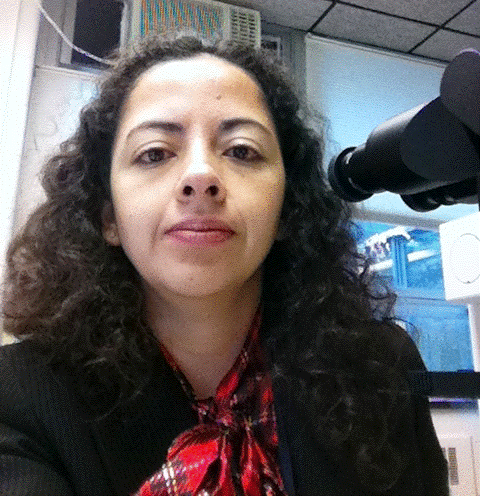
Dear Friends and Colleagues:
I am interested in buying a couple of muscle and nerve pathology books that are currently out of print in their editorial houses:
Pathology of Skeletal Muscle by Stirling Carpenter and George Karpati Oxford University Press, USA; 2 edition (January 15, 2001)
ISBN-10: 0195063643
ISBN-13: 978-0195063646
Atlas of Peripheral Nerve Pathology by R.H. M. King A Hodder Arnold Publication; 1st edition (July 15, 1999)
ISBN-10: 0340586664
ISBN-13: 978-0340586662
Please let me know if anybody is interested in selling a second hand copy that you are not currently using or if anybody knows where I can purchase them directly.
Thank you all for your help,
Sandra Camelo-Piragua, M.D.
Clinical Assistant Professor
University of Michigan
Pathology Department
Neuropathology Division
1301 Catherine Rd.
Medical Science Building I. Room M4213
Ann Arbor, MI 48109
e-mail: sandraca@umich.edu
Friday, March 25, 2011
Best Post of October '10 -- Army General on Blood Test for Concussion: "This is huge"
The next in our Best of the Month series is from October 15, 2011:
USA Today ran a story today about a simple blood test that the US Army has developed which may objectively test for the presence of concussion. The Army collaborated with Banyan Biomarkers, a Florida-based company, to develop the test. In checking Banyan's website, it looks as though the test consists of a panel of immunoassays which include SBDP145, SBDP120, UCH-L1, MAP-2, GFAP. If this test turns out to be as good as the Army is implying, the implications for those on the battlefield (and on the football playing field, I might add) are enormous. If it pans out, I would agree with Gen. Peter Chiarelli, the Army vice chief of staff, who is quoted in the article as saying: "This is huge."
Thanks to Dr. Doug Shevlin for alerting me to this news story.
USA Today ran a story today about a simple blood test that the US Army has developed which may objectively test for the presence of concussion. The Army collaborated with Banyan Biomarkers, a Florida-based company, to develop the test. In checking Banyan's website, it looks as though the test consists of a panel of immunoassays which include SBDP145, SBDP120, UCH-L1, MAP-2, GFAP. If this test turns out to be as good as the Army is implying, the implications for those on the battlefield (and on the football playing field, I might add) are enormous. If it pans out, I would agree with Gen. Peter Chiarelli, the Army vice chief of staff, who is quoted in the article as saying: "This is huge."
Thanks to Dr. Doug Shevlin for alerting me to this news story.
Friday, March 18, 2011
Unique Pediatric Neuropathology Mentorship Opportunity Announced
Dr. Christopher Pierson today asked me to post the following recruitment letter for early-career neuropathologists. If you are a more senior neuropathologist, please pass this announcement on to your junior colleagues:

Dear Neuropathologist,
The Children’s Oncology Group Young Investigator (COG-YI) mentor/mentee program is currently soliciting applications for potential mentees. The purpose of this program is to provide an avenue for younger members of the COG with a defined interest in a specific pediatric tumor, such as brain tumors, to get involved with research. The program identifies mentors from the pathology discipline already involved in research with the defined tumor of interest. Limited travel funds support the ability for mentors and mentees to meet at yearly COG meetings, and for YI mentees to present progress in their research at the yearly fall meeting. The program does not fund specific research projects, but can help direct individuals to other funding sources if needed.
Requirements for potential mentee:
1. Children’s Oncology Group (COG) Member
2. Less than 10 years from completion of fellowship/residency
3. Precise area of interest within a specific pediatric tumor
4. Completed application (see below).
An optimal mentee is an individual with a defined focus in a specific pediatric tumor. Mentees should submit a project proposal related to this area of interest that utilizes resources unique to the COG, such as H+E slides, paraffin sections, tissue microarrays, and in some cases frozen samples. Mentees will be paired with a COG pathology mentor active in the disease discipline of interest to further develop and carry out the project. Some pairings may mature to a young investigator mentee becoming a tertiary reviewer for that disease discipline.
This three-year program is aimed to provide guidance to COG young investigators who have matured in their career to a level of interest in one particular pediatric tumor. Those who are still exploring or examining various subjects within pediatric tumors should not apply. Interested applicants must apply by June 10th, 2011 to meet at the Fall 2011 meeting in Atlanta. Specifically, for the pathology mentees, limited funding is available from the COG Pathology Committee for travel to accomplish a specified project. According to the COG policies, the travel funding is set at a maximum of $1000.
To apply for the COG YI pathology mentorship program, please prepare the following:
1. Project proposal (1-2 pages with brief description of background, hypothesis, proposed methods, with brief references).
2. Curriculum vitae
3. Letter of support from Department Chair
4. Documentation of COG membership (can be obtained at the COG website)
Completed applications should be sent to:
Chris Pierson, M.D., Ph.D
COG Pathology Committee YI Liaison
Christopher.pierson@nationwidechildrens.org
Subscribe to:
Posts (Atom)
-
Neuropathology Blog has run its course. It's been a fantastic experience authoring this blog over many years. The blog has been a source...
-
 A neuropathology colleague in Toronto (Dr. Phedias Diamandis) is developing some amazing AI-based tools for pathology and academia. He hel...